
TECH & TOOLS
GEO AGENCY,
YOUR PLACE IN AI ANSWERS.
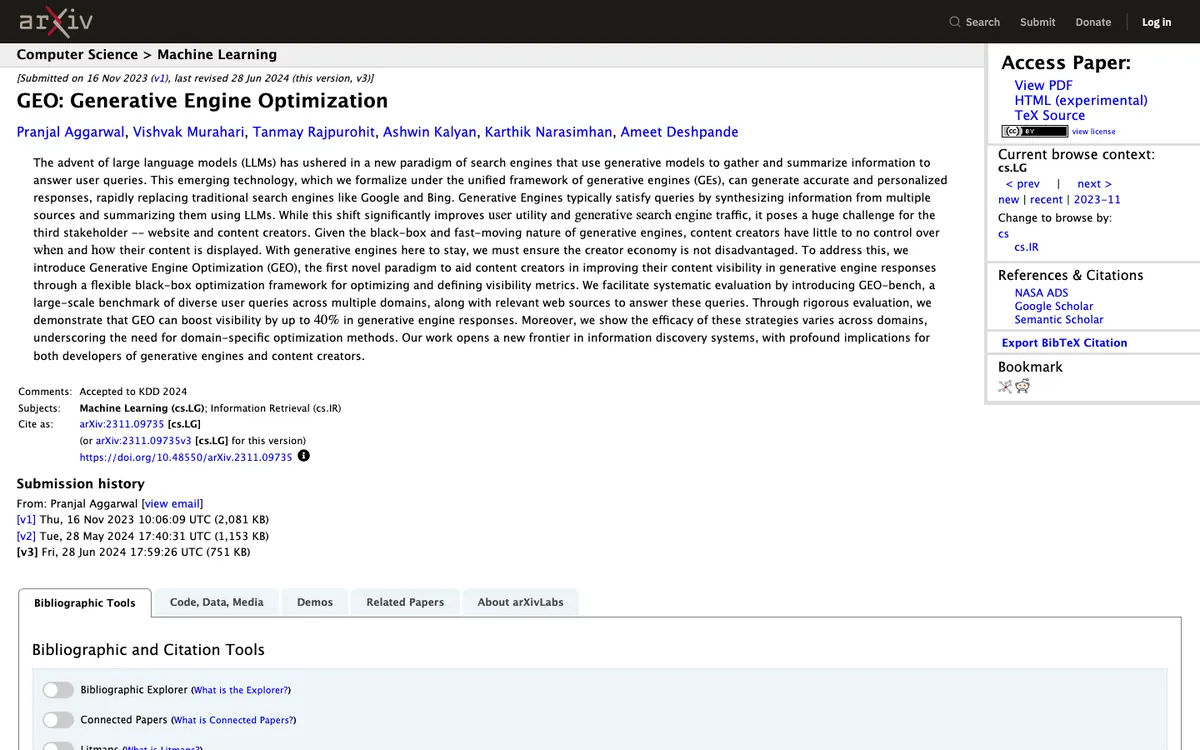
GEO (generative engine optimisation) measures and improves a brand's visibility in the answers of AI engines. We start from what the AIs answer, then from the sources that feed them.


GEO AT A GLANCE
GEO at a glance.
GEO is a practice, not software. The term comes from a research paper published in late 2023 by researchers from Princeton, Georgia Tech, the Allen Institute for AI and IIT Delhi: it measures a source's place in answers written by an AI, where SEO measures a position in a list of links.
Related expertise AI listening, Search listening
Related offer Social Insights
The other tools Talkwalker, Visibrain, YouScan, SoPrism, Radarly, Brandwatch, Sprinklr, Semrush, Google Trends, AnswerThePublic, ChatGPT, Meta Ads, Google News, Social Blade, Claude, Gemini, Perplexity, Grok
WHAT IT DOES
What GEO measures.
Your share of answer
On your category's questions, how often you are cited.
The sources that count
The sites, articles and forums the AIs draw on.
Engines compared
ChatGPT, Gemini, Perplexity and Google's AI Overviews do not cite the same brands.
The levers
The content to produce or correct, and where.
GEO AGENCY
Why work with a GEO agency?
GEO is not bought like software. A GEO agency like Licter first measures what AI assistants answer, then acts on the sources they read: here is how we go about it.
GEO done in-house
- AI answers checked at random, once
- Content rewritten without knowing what the models read
- No measure before or after
- Wrong sources left online
 GEO with Licter
- The same questions put to each model, several times
- The sources the assistants cite, collected one by one
- A first measure, then monthly or quarterly tracking
- A plan: the sources to correct or to feed
You know what AI says about you, and what to change.
- 01
Framing
We start from the decision to make, not from a keyword list: the perimeter follows the question.
- 02
Collection
Queries, sources, languages and periods, set by the consultants who will read the output themselves.
- 03
Reading
An analysis crossed with our other sources, and a recommendation your teams can act on.
WHAT WE DELIVER
What we deliver in GEO.
GEO diagnostic
- Your share of answer against competitors
- Questions where you are absent
- Sources that cite you or not
- The priorities

Monthly tracking
- The same question panel
- How your visibility changes
- Newly cited competitors
- A summary note

Content recommendations
- Topics to cover
- Sources to work on
- Information to correct
- The link with your agencies

USE CASES
GEO: the use cases where it counts.
Each card leads to the use case it contributes to.


LIMITS AND COMPLEMENTS
The limits of GEO, and how we make up for them.
! Limit
Answers that move
Engines change often: that is why we follow the same question panel over time.
GEO What we make up for
! Limit
No guarantee
Nobody controls an AI's answer; you act on the sources, and measure the effect.
GEO What we make up for
+ We cross it with
ChatGPT
The brands cited on your category's questions, and in which order.
ChatGPT See the page ↗
+ We cross it with
Perplexity
Each answer lists the sites used: you see where your brand's image comes from.
Perplexity See the page ↗
+ We cross it with
Gemini
The brands cited on your questions, and in which order.
Gemini See the page ↗GEO, IN DETAIL
What to know before you work on your place in AI answers.
Written by Antoine Khaitrine and Adrien Krebs, co-founders of Licter · updated 19 October 2026
What is GEO?
GEO, or generative engine optimization, covers the actions meant to make a brand, a product or a source appear in the answers written by an AI. Those answers come from ChatGPT, Gemini, Perplexity or Google's AI Overviews. They do not point to a list of links: they give an opinion, a recommendation, a name, directly.
The word GEO was coined in a research paper posted in November 2023, then presented at the KDD conference in 2024. Its authors built a test bench of 10,000 questions, called GEO-bench, and tried nine ways of rewriting a page. They conclude that some rewrites raise a source's visibility in the answers by up to 40%, depending on the domain.
How an AI chooses its sources
An AI builds its answer from two reservoirs. The first is its memory: the texts read during training, frozen at a date. The second is web search: the assistant reads pages live and cites its links. ChatGPT uses both, Perplexity searches on every question, Gemini relies on Google Search. The gap between memory and search explains many outdated answers.
The choice of pages also depends on technical rules. Google explains that its AI Overviews and AI Mode run several related searches in parallel, on subtopics, before writing. OpenAI states that a site blocking its search crawler, OAI-SearchBot, no longer appears in ChatGPT's search answers. The first check is therefore simple: can these crawlers read your pages?
Which content do AIs cite?
The content AIs cite has one thing in common: it gives a clear answer that is easy to reuse. In the founding GEO paper, the most effective rewrites add quotations, statistics or references to sources. The authors checked this result on Perplexity, in real conditions. A vague or purely promotional text offers little to hold on to.
In practice, a page useful to an AI answers a precise question in its first lines. It gives dated, verifiable facts: prices, features, conditions. It stays up to date, because old information ends up repeated as true. The work concerns your own pages as much as other people's pages that talk about you.
What GEO cannot promise
GEO cannot guarantee a place in an answer. Nobody controls what an AI writes: not the brand, not its agency, not a consultant. Engines change model, sources and rules without warning. An offer that promises to be "first on ChatGPT" promises something it does not control.
What GEO allows is to act on the sources that feed the answers, then measure the effect on the same question panel. Nor does it replace social listening: an AI does not read the whole social conversation. And it does not say how many people ask these questions; for that, you need search listening.
GEO agency or consultancy: what you buy
With a GEO agency or consultancy, you do not buy software, but a method and a reading. The choice of questions, engines and competitors, the repeated measures, the record of sources and the recommendation are taken care of. Your teams receive a list of priorities, not a dashboard to run.
Licter is an independent consultancy, with no tie to the AI publishers. We measure, explain and recommend; content production stays with your teams or agencies, with whom we make the link. To start, a first thirty-minute call with a consultant is enough to frame the question.
GEO and SEO: what is the difference?
GEO and SEO do not measure the same thing. SEO aims for a position in a list of results, then a click. GEO aims for a mention in a text written by a machine, which the user often reads without clicking. A brand can rank well on Google and be absent from an AI's answers, or the other way round.
The two disciplines still overlap. Google says so in its documentation: to appear as a link in AI Overviews or AI Mode, a page must be indexed and eligible to show with a snippet, with no special optimization. On the other hand, the founding GEO paper notes that keyword stuffing, an old SEO recipe, brings almost nothing in an AI answer.
How to measure your visibility in AI answers
Visibility in AI answers is measured from a panel of questions. They are the ones your customers ask: "which brand to choose", "what is the difference between", "is it reliable". On that panel, you count how often your brand is cited, in which position, against which competitors. That is what we call the share of answer.
A reliable measure needs repetition. The same question does not always give the same answer: so we ask each question several times, on each engine. On ChatGPT, we ask it with and without web search, to separate its memory from what it reads today. Finally, we record the sources cited, to know where each mention comes from.
Measurement is done engine by engine, because ChatGPT, Gemini, Perplexity and Google's AI Overviews do not cite the same brands. For instance, we compare Gemini and the AI answers of Google Search on the same questions, then trace back to the pages and listings that feed them. A good score on one engine says nothing about the others.
The role of the press, forums and Wikipedia
The press, forums and review sites weigh heavily in AI answers, because there a brand is described by others than itself. On Perplexity, which shows its sources, recent pages, articles and discussions come back often. A brand absent from these spaces has little chance of being recommended, even with an excellent site.
Wikipedia plays a special role. The encyclopedia is part of the declared training data of models such as GPT-3, and it often serves as the reference to describe a company. A wrong or outdated entry can therefore end up in an AI's memory. You do not fix it yourself: Wikipedia's rules strictly govern conflicts of interest.
How long before you see an effect?
The time a GEO effect takes depends on the reservoir the AI uses. When it searches the web, like Perplexity or ChatGPT with search, a new or corrected page can be picked up as soon as it is found. When it answers from memory, nothing moves before a new model comes out, and nobody knows that date in advance.
That is why we start from a first measure, then follow the same panel every month or every quarter. Since answers vary from one try to the next, only a series of comparable measures tells whether a change is real. A one-week gap on a single question proves nothing.
How to choose a GEO agency: five questions to ask
How do you measure our visibility before acting? Without a starting measure, no result can be shown. On which questions and which models? They should be your customers' questions, put to the assistants they use, and several times, since answers vary.
How do you identify the sources the assistants cite? That is where most of the work happens. What do you deliver, and how often? A list of priorities is worth more than a dashboard. Finally, how will we know it works? Beware of a guaranteed position: nobody controls a model's answers.
Sources arXiv · GEO: Generative Engine Optimization (2023), arXiv · GEO-bench, version 3, Google Search Central · Fonctionnalités d'IA, OpenAI · Overview of OpenAI crawlers, Wikipédia · Conflit d'intérêts, arXiv · Language Models are Few-Shot Learners (GPT-3)
FAQ
Frequently asked questions about GEO.
Is Licter a GEO agency?
Yes: GEO is a practice, not software. We measure what AI answers about your brand, where those answers come from, and what to change to appear in them. Licter is an independent consultancy.
Do you produce the content?
No: we measure, explain and recommend; production stays with your teams or agencies.
How much does a GEO audit cost?
On quotation: the price depends on the number of brands, questions, AI assistants and markets followed, and on how often we measure. After a first thirty-minute call, we send a costed proposal.
How do you measure a brand's AI visibility?
We put your customers' questions to each assistant, several times, and record the brand's presence, rank, tone, the accuracy of the facts and the sources cited. The same measure, repeated every month or quarter, shows what changes.
TIME TO ACT
Looking for a GEO agency?
Send us the question. If another approach answers it better, we will tell you.
NOTED, A CONSULTANT GETS BACK TO YOU WITHIN 30 MINUTES, ON WEEKDAYS FROM 9AM TO 7PM